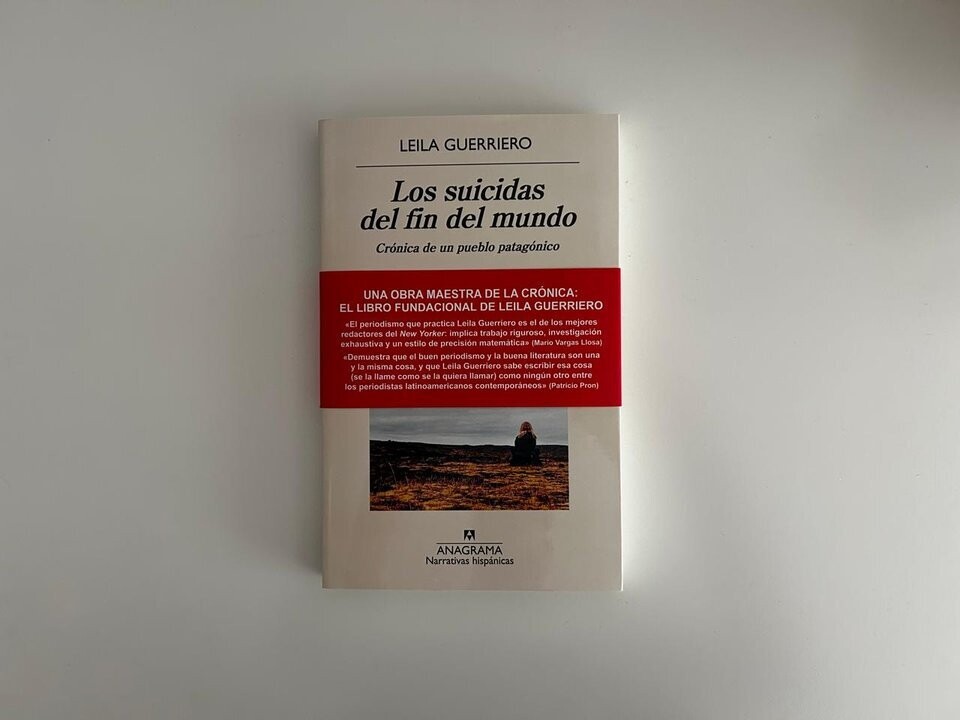
More than 20 years after its original publication, 'The Suicides at the End of the World' returns to bookstores in a new edition that confirms its status as a contemporary classic. First published in September 2005, the book by Leila Guerriero has become an essential piece of Argentine narrative journalism. The recovery of the title by Anagrama revives an investigation that, far from losing strength, dialogues with a present traversed by economic crises and social tensions that recall the origin of that tragedy. The starting point was a series of deaths that shook Las Heras, in the north of Santa Cruz. That gesture—to listen, to narrate, not to simplify—is what transformed that investigation into a milestone of contemporary Argentine journalism. The oil-producing Patagonia, a scenario of labor conflicts and cyclical adjustments, reappears as a mirror of a country that repeats structural tensions. Two decades after its appearance, 'The Suicides at the End of the World' persists as an uncomfortable reminder: behind the figures and headlines are stories that have no easy explanation. Guerriero's chronicle does not close the enigma of Las Heras, but rescues it from oblivion and turns it into written memory. Her bet was another: to build a coral narrative where the voices of the bereaved—“the lonely, the shattered into pieces”—outline a human map traversed by loss, silence, and the impossibility of understanding. With a dry and precise prose, far from sensationalism, the author turned the landscape into another character. But she also collected the weight of an economic context that had transformed the town. A synthesis of the Menemist era Las Heras had grown thanks to the railway and state oil exploitation. For decades, the Los Perales field turned Santa Cruz into one of the country's main basins. In 1995, unemployment in the area rose to 20% and thousands of people abandoned the town. The chronicle advances as a contained descent, without plot twists, sustained by attentive listening and an ethics of detail that avoids judgment and sensationalization. The book consolidated Guerriero as one of the central voices of the genre in the Spanish language. With over 25 years of career in media such as La Nación, Rolling Stone, and Granta, and author of titles like 'Plano Americano', 'Zona de Obras', 'Opus Gelber', 'La dificultad del fantasma', and 'La llamada', the journalist found in 'The Suicides at the End of the World' a form that would mark her later work: rigorous investigation, literary structure, and a gaze that privileges complexity over slogans. A story that could repeat itself The new Anagrama edition not only recovers a key text, but inscribes it in a present that once again questions regional economies and communities dependent on extractive industries. From having around 50,000 employees nationwide, the company went to about 5,000. Between 1997 and 1999—although the cases extended until 2000—at least twelve young people, and a total of twenty-two people, committed suicide in that oil town battered by wind and isolation. The promised progress gave way to precariousness, unemployment, and fragmentation. In that scenario, the death of young people around 25 years of age acquired a collective dimension. The book offers no closed answers or conclusive theories. “The data says but never explains,” writes Guerriero. However, the privatization process of YPF initiated in 1991, under the government of Carlos Menem, implied massive layoffs and a brutal reconfiguration of the social fabric. The constant wind, the dust, the endless night, and the feeling of exposure function as a backdrop and metaphor for a community adrift. She listened for months to contradictory versions: rumors about sects, superstitions linked to old indigenous cemeteries, hypotheses about social contagion.